
Tresor AI changelog
The Tresor Inference API is live
This is a big milestone for Tresor, and an important one for customers who want to build on private AI without lowering their standards. You can now build directly on top of Tresor with an OpenAI-compatible API, while keeping the privacy, sealed execution, and proof that make the product different.
OpenAI-compatible from day one
Point your existing OpenAI client at Tresor, use a tr- API key, and start making requests. The API supports streaming out of the box, and newer capabilities like tools and reasoning content are there from the start.
🔒 Privacy: The API keeps the same zero-access design people expect from Tresor.
A proper product, not just an endpoint
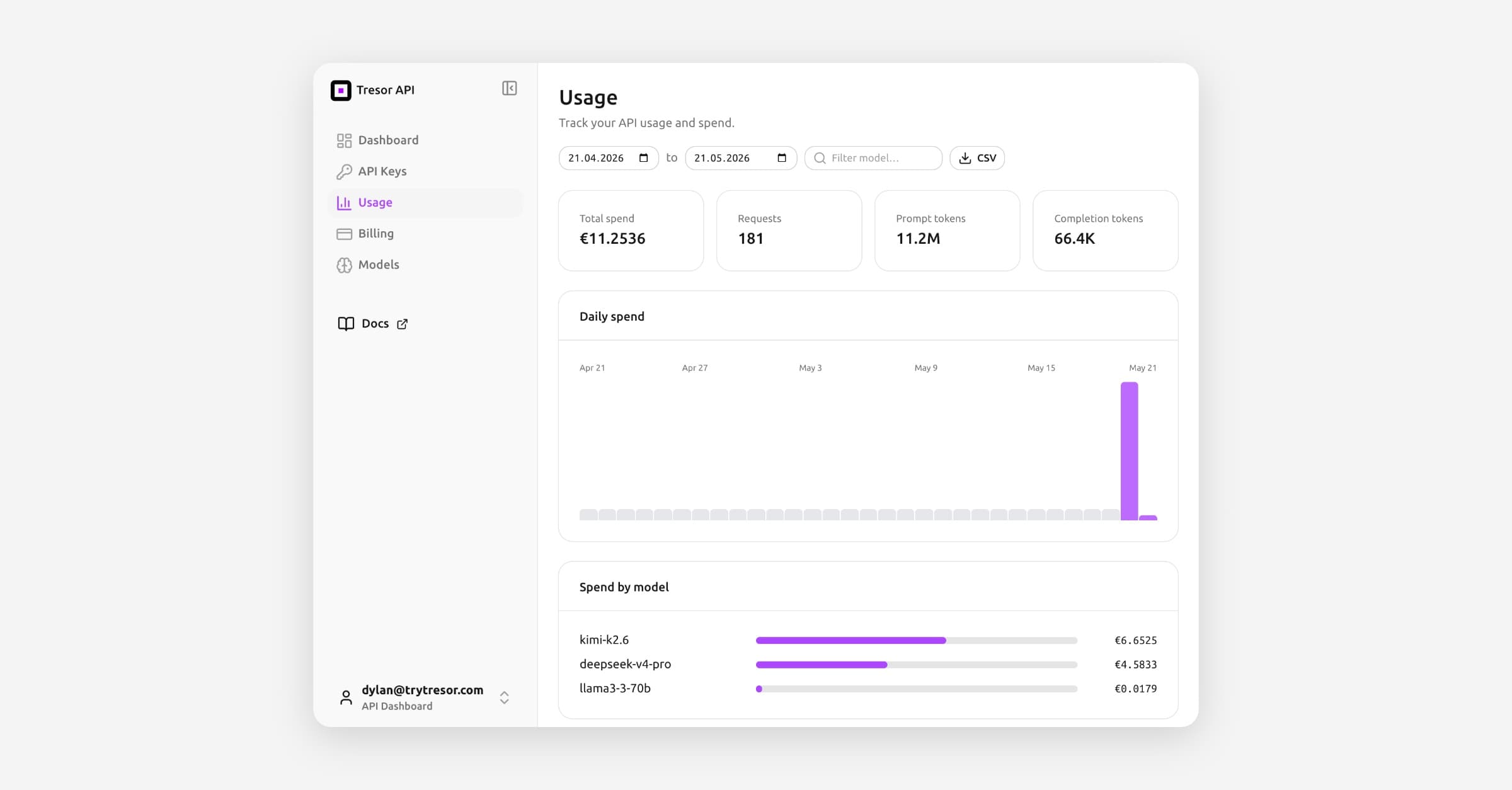
The new API dashboard gives you the basics you actually need on day one:
API keys — Create and revoke keys from the dashboard, with clear prefixes and last-used visibility.
Usage tracking — See spend over time, break it down by model, inspect individual rows, and export usage as CSV.
Billing — Add credits, save payment methods, download invoices, and turn on auto-recharge.
Operational emails — Get clearer alerts for low balance, depleted balance, payment failures, and API key activity.
Verifiable by default
Every API response can be tied to a signed receipt you can fetch and verify later. That receipt freezes the routed model, cryptographic fingerprints of the request and response, and the attestation trail behind the call.
If you want a stronger guarantee than TLS, tresor-attest lets your client verify it's talking to the genuine Tresor workload before any payload leaves your process.
Also in this launch
OpenAI SDK examples — Quick-start docs for curl, Python, Node.js, and Go.
Receipts in the dashboard — Usage entries make it easier to inspect verification details and timestamps.
First-release polish — Better invoice empty states and fewer rough edges when creating new API keys.
This is the first release of the Tresor API, and it sets the baseline for what we want this product to feel like: easy to adopt, easy to operate, and much easier to trust.