
Tresor AI changelog
Shorter route IDs, clearer routing
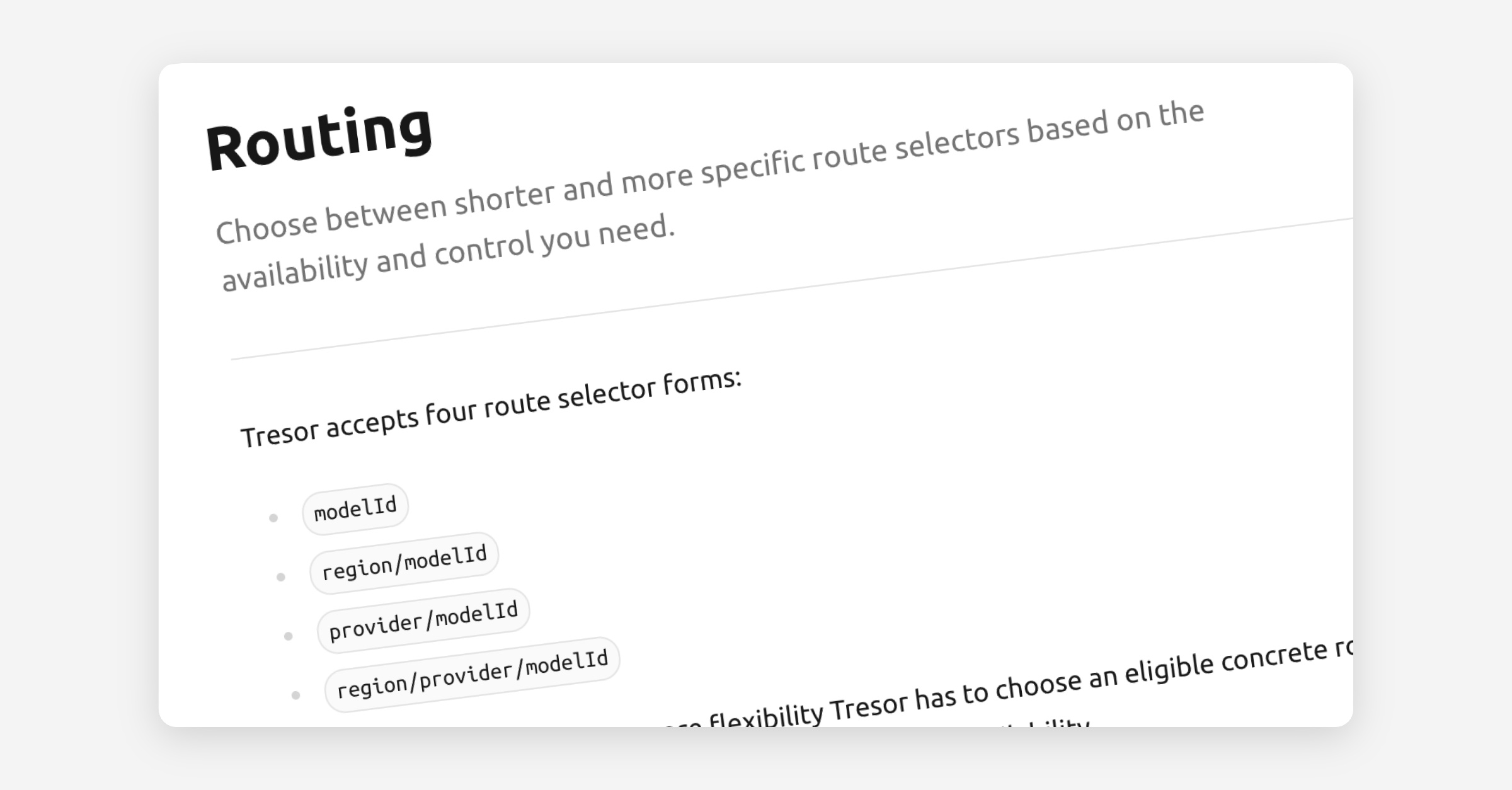
Choosing routes in the Tresor API just got simpler. You can now use shorter canonical selectors like gpt-oss-120b, eu/gpt-oss-120b, or tresor/gpt-oss-120b more consistently across requests, failover lists, and model discovery instead of reaching for a fully pinned route every time.
The practical benefit is better availability with less route bookkeeping. If you only care about the model family, or the model plus one region or provider, Tresor keeps more eligible concrete routes available behind that selector.
Use the shortest route that fits
Shorter selectors are now the clean default - The same canonical route forms now show up consistently in
model, chatfailover,tresor.requested_route, and the published model catalog.Availability stays higher when you do not over-pin - A bare model key gives Tresor the most room to keep requests moving, while region or provider selectors let you narrow the route only when you actually need to.
Model discovery is easier to reason about -
GET /v1/models?detail=truenow publishes logical, region, provider, and concrete routes in one flat catalog, androute_idfilters accept canonical as well as compatibility IDs.
Read our new Routing Docs to find out more.
Pin deliberately when it matters
You can still pin a full route when pricing, residency, prompt caching, or reasoning behavior needs to stay fixed. The difference is that the contract is clearer now: shorter routes buy flexibility, fully pinned routes buy control.
We also refreshed the docs and model catalog views around this behavior, including a new Routing concept page and clearer failover guidance, so it is easier to understand what the router may still choose on your behalf.
Compatibility: This does not change compatibility with our previous modelID schema. So routes like eu/auto/gpt-oss-120b continue to work and you can migrate to the new schema when you are ready.